VNPF
Engelstalige versie van ‘Poppodia en -Festivals in Cijfers 2025’ beschikbaar
11 november 2026
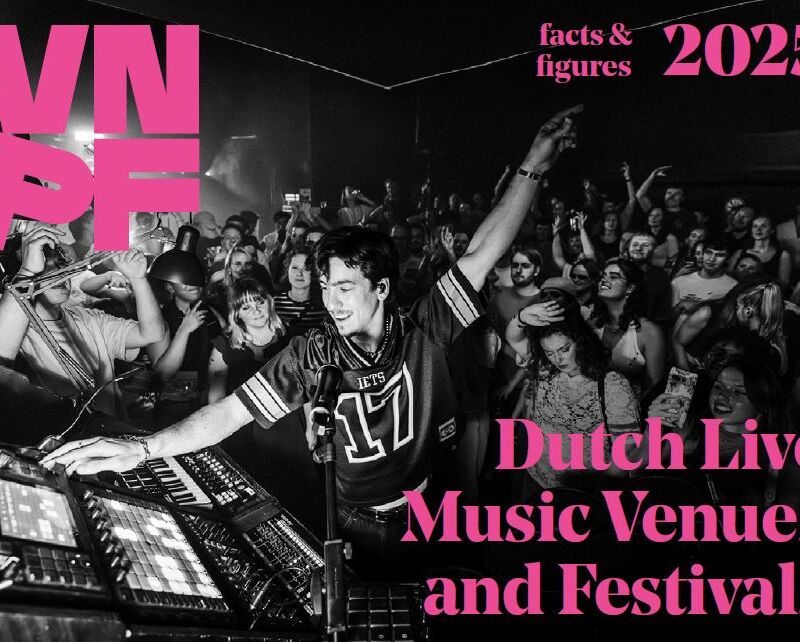
Van de publicatie 'Poppodia en -Festivals in Cijfers 2025' is nu ook een Engelstalige versie beschikbaar.
The report 'VNPF Dutch Live Music Venues and Festivals - Facts & Figures 2025' is now available in English.
Rising costs, declining audiences and insufficient subsidy increases put the financial and artistic position of many music venues under pressure
Dutch live music venues welcomed 5% less visitors in 2025 than in the previous year. Club nights in particular saw a decline in attendance. At the same time, the total expenditure increased faster than the total income. As a result, over half of the music venues ended the year with a negative financial result.
This is according to new figures from the Association of Dutch Music Venues and Festivals (VNPF). The analysis is based on data from 55 venue members. Although the financial situation varies considerably from one venue to another, the financial situation of many of the (predominantly non-profit) organisations is under pressure. Employment, housing and programming are becoming more expensive.. Municipal subsidies are not increasing sufficiently everywhere to keep pace with the rising costs. As a result, some venues are having to draw on their reserves, make cutbacks, or seek additional support from their local authorities.
Club nights see the sharpest decline in visits
In 2025, the Dutch music venues presented 29,523 artist performances, attracting a total of more than 6.4 million visits. This represents a fall of almost 5% in audience numbers compared with 2024, although attendance was still 3% higher than in 2023. The decline was primarily due to falling attendance at club nights. The number of visits to club nights decreased by 14% compared with 2024. The average number of visits per club night also decreased, as did the number of club nights that sold out.
At the same time, the overall picture is mixed. Concerts attracted more visitors than they did two years ago. Music venues also presented more programmes outside their own accommodation, demonstrating their wider role in cities and regions. They contribute to talent development, audience development and accessibility by organising events in schools, museums, community centres, churches, parks and other locations.
The averages also mask considerable local differences. For example, 60% of music venues reported a decline in attendance at club nights, while 40% saw an increase. In terms of concert attendance, approximately one third of venues reported a decrease, while around two thirds recorded an increase.
Expenditure increasing faster than income
Total income for music venues amounted to €247 million in 2025, while total expenditure reached €251 million. Income increased by 2% compared with 2024, while expenditure rose by 2.3%. As in the previous year, costs are therefore increasing faster than income. For more than half of the venues, this resulted in a negative financial result in 2025.
The reasons varied from venue to venue. For many, fixed costs, particularly staffing and premises, increased significantly. At the same time, income from ticket sales and food and beverages came under pressure, partly because club nights attracted less visitors.
Municipal subsidies did not provide sufficient compensation for rising fixed costs everywhere. In 2025, many municipalities began a new four-year funding period, often aligned with the national cultural policy period (2025–2028). As a result, many music venues were allocated new subsidy amounts for 2025. The figures show that almost a quarter of venues received less municipal subsidy in 2025 than in 2024. In addition, funding remained unchanged for some venues. Even where municipalities do apply indexation, the increases are not always sufficient to cover rising costs.
Development of emerging talents under pressure
Financial pressure affects more than the day-to-day running of venues. Their artistic and social functions are also at risk. Limited financial resources make it increasingly difficult to take artistic risks. This affects the diversity of programming, the development of new audiences and performance opportunities for emerging artists.
Together, music venues form an important live circuit for the Dutch music industry. This is where artists gain valuable stage experience, build an audience and gradually develop their careers. Small and medium-sized venues are often where emerging talent gets its first opportunities. They provide a space for artists to experiment and allow audiences to discover performers who are not yet ready to fill larger venues.
From this circuit, artists progress to larger venues, festivals and wider national and international audiences. If opportunities for risk-taking in programming, club nights, niche genres and emerging artists become more limited, the development pathway for new talent is put under pressure. This affects not only individual venues, but the Dutch music ecosystem as a whole. Without a strong live circuit, it becomes harder for emerging artists to develop, gain experience and build an audience.
These concerns are particularly urgent as discussions continue about a new cultural funding system in the Netherlands. If national support for cultural infrastructure, programming and geographical distribution is reduced, music venues will become increasingly dependent on municipal operating subsidies. These vary considerably between municipalities and are not sufficient everywhere. A strong music ecosystem therefore requires more than simply covering fixed costs. It also needs sustained investment in programming, talent development and audience development.
Local circumstances remain decisive
The VNPF emphasises that the situation at each venue must be assessed individually, taking local circumstances into account. Some music venues are expanding their audiences and managing to absorb rising fixed costs. Others are facing declining attendance, insufficient subsidy increases or limited financial reserves. Only by taking the local context into account can the support needed to preserve and strengthen the cultural role of music venues be properly determined.
“Music venues are much more than concert halls,” says Berend Schans, director of the VNPF. “They curate programmes, develop talent, build audiences and form an indispensable link in the Dutch music ecosystem. But fulfilling this role requires financial conditions that reflect today’s realities. If fixed costs continue to rise and the resources available for programming become increasingly limited, the diversity, innovation and accessibility of what we offer will ultimately also come under pressure.”
All figures
The full report ‘VNPF Dutch Live Music Venues and Festivals- Facts & Figures 2025′ contains data on programming, audiences, workers, income and expenditure from 55 music venues and 43 festivals.